

The updated Umpire Pathway offers one clear line of progression from beginner club hockey through to elite national matches, keeping officiating up to speed with the modern game.
Why Are We Changing?
Modern hockey moves fast, and our officiating structure needs to keep pace. The updated pathway addresses long-standing challenges to offer a clear, modern system for every official.
Challenges We Are Overcoming
- Confusing Progression: Slow, unclear steps that take too long to move through
- High Drop-off: Many officials finish beginner modules but never complete their final assessment
- Inconsistent Standards: Varying grading rules and support quality across different Areas
- Outdated Alignment: Old qualifications tied to outdated league structures
What the New Pathway Delivers
- Five Clear Grades: One simple ladder from Grade 5 (Club) to Grade 1 (Elite / National)
- Aligned to Leagues: Qualification levels match competition structures directly
- Centrally Managed, Locally Delivered: National standards backed by friendly local support
- Consistent Guidance: Equal development and mentoring opportunities wherever you live
- Simple Maintenance: Clear, ongoing steps to keep your qualification active
Pathway at a Glance
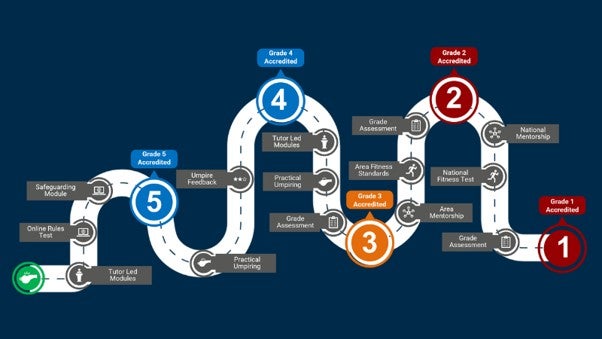
Grade Breakdown Summary
-
Environment: Club hockey and local junior matches
Training: Rules Learning & Assessment, Safeguarding Training and tutor-led Umpire Core Skills Modules
Maintenance: Take part in at least three officiating hockey activities, games or tournaments over three years, complete Critical Rule & Guidance updates as they are released by EHO, and maintain EHO membership.
-
Environment: Club and lower league matches
Training: Complete five practical on-pitch activities at Grade 5 within three years
Maintenance: Umpire a minimum of five Grade 4 games every three years, complete Critical Rule & Guidance updates and maintain EHO membership
-
Environment: Club matches in higher competitions with Area appointing where suitable
Training: Complete the required Grade 3 learning and five Grade 3 games, which can include a formal Grade 3 assessment
Maintenance: Umpire a minimum of five Grade 3 games every three years, complete Critical Rule & Guidance updates and maintain EHO membership
-
Environment: Top-level Area and Grade 2 competitions, with National opportunities where appropriate
Training: Area mentorship, formal assessment, and fitness standards
Maintenance: Minimum five Grade 2 games every two years, required fitness standard, Critical Rule & Guidance updates, EHO membership and ongoing CPD, mentoring, coaching and feedback
-
Environment: National and high-performance domestic hockey
Training: National nomination and mentoring, fitness standards and formal Grade 1 assessment
Maintenance: Minimum four Grade 1 games every year, required fitness standard, Critical Rule & Guidance updates, EHO membership and ongoing mentoring, coaching, CPD and development
Transition to New Pathway
Full detail on the transition timeline, and what the changes mean for adult leagues and junior competitions, is covered on the Transition & Implementation page (link).
FAQs
What are the five new umpire grades?
The new pathway has five grades, from Grade 5 through to Grade 1. Grade 5 is the entry point for club and local hockey, while Grade 1 is the highest domestic grade and supports umpires operating in national and high-performance hockey.
These new grades will replace the current Levels 1, 2 and 3.
Do I have to start at Grade 5?
Grade 5 is the normal entry point for new umpires. However, existing umpires will be mapped into the new pathway based on their current accreditation, practical experience and other relevant information as part of the transition to September 2027.
Some training may allow umpires to enter the pathway at other grades and assistance and support will be given where there is no Grade 5 hockey available.
Do I need to complete a formal assessment at every grade?
No, unlike the current system, formal assessments won’t happen at every grade.
Formal qualification assessments are part of the pathway at Grades 3, 2 and 1. Grades 5 and 4 are achieved through the required learning and practical development activities.
How do I move from one grade to the next?
Each grade has clear requirements for achievement, including the appropriate learning, practical experience and, where required, formal assessment. Once you achieve a grade, you also need to meet its ongoing maintenance requirements to keep it active.
What happens if I stop umpiring?
Each grade has defined maintenance requirements. If you do not remain active at the required level, your grade will become inactive and you will need to complete the necessary requirements to regain the grade.
Will my grade be recognised if I move to another Area?
Yes. The new grades are nationally recognised, so your grade moves with you if you move Area or club.
How It Impacts You
Choose your role below to see how the new pathways work for you.
What This Means For Clubs
I’m a Club - Understand your role in developing and supporting umpires
Learn More
What this meaning for umpires
I’m an Umpire Find your starting point and progression routes
Learn More
What this means for Umpire Developers
I’m an Umpire Developer - Understand how to become and progress in supporting umpires
Learn More